There are 43 options in the Format list that can be used to describe editions. This is my attempt to help us make sense of this, and see if we have suggestions to change things.
Each of the 43 formats we currently have is listed below as a…
bold, bulleted head item, followed by my attempt at a description
There are bound to be some things missing. For instance if I have a Large Print or Braille version of a book, that’s something I’d want to record.
Cover type
Hardback: Rigid cover that typically extends over the cut pages, providing better shelf-life.
Paperback: Paper cover that is trimmed to the cut pages.
Soft cover: Flexible cover (not paper), leather, plastic etc.
Board book: Usually aimed at young children and infants, of a few pages made of thick rigid board.
Padded Baby Book: A tactile, padded book that is suitable for teething infants.
Binding type
Flexibound
Loose-leaf/Binder
Spiral-Bound - Uses continuous metal (or plastic) coil or comb that is threaded through holes puched in the printed material. This produces a book that opens flat and rotates 360 degrees. Widely used for notebooks, manuals, cookbooks, and workbooks.
Book size
Mass-Market Paperback: a book size chosen to be economical for high print-run editions
Trade Paperback: a book size that typically matches an equivalent hardback edition. Usually retailing at a lower price.
Pocket book: A small highly portable book size.
Miniature book: A very small book size, typically less than 3 inches width or height. Miniature book - Wikipedia
Combined packaging
Hardback + CD
Paperback + Cassette
Paperback + CD
Paperback + Flexi-Disc
Box Set: generally descriptive of two or more books (or volumes) packaged together in a box. A single boxed book, cased edition, would not be considered to ba a boxed set.
Historical classifications
Codex:
Historical ancestor of the modern book, typically hand-written on vellum, parchment or papyrus. Codex - Wikipedia
Incunable: A Book, Pamphlet or Broadside produced during the eariest stages of printing (pre-1500). Incunable - Wikipedia
Post-Incunable: A printed book from the early period of book production (early 1500s) where the book had started to become a standardised artefact, including title pages, author names, dates, printing locations etc. Incunable - Wikipedia
Pamphlet: A unbound book of several cut pages (could be stitched, glued or stapled). Pamphlet - Wikipedia
Audio formats
Formats intended to be listened to rather than read.
Audiobook: A book in recorded format that is read out loud by one or more voice actors (real or artificially voiced). Issued in cassette, CD, or electronic format.
Electronic formats
Formats intended to be read on portable e-readers and computers.
e-Book: Electronic book.
e-Zine: Electronic periodical.
Periodicals
Some of these formats are actually magazine sizes that were typical for US publications
Magazine
Pulp Magazine: periodical printed cheaply on wood pulp paper. Pulp magazine - Wikipedia. Also a specific magazine size in the US.
Bedsheet Magazine: Also known as a Large Pulp, is a periodical printed cheaply on wood pulp paper, but of a larger format than a Pulp Magazine_. Bedsheet - Wikipedia
Digest: Magazine size: smaller than a Journal but larger than a typical paperback book.
Journal: Magazine size
Zine: Amateur produced magazine, usually devoted to specialist content. Often of a small size do to production, i.e. folded Letter or A4 paper.
Other standalone formats
Facsimilie: Reproduces an earlier edition of the same book. [This could be used in combination with other formats, e.g. Hardback.]
Club Edition: [Not sure what the thinking is with this one. Do we add this for editions marketed by Book Clubs? The imprint should be enough.]
Manuscript: Literally a document written by hand (pen or typewritten).
Printing/Uncorrected Proof: Copies typically distributed to readers for quality control and editing.
Promo: [Promotional copy I guess - Feels like this would need to be a special print-run distinct in some way from commercial editions? Maybe it’s just the first couple of chapters?]
Special book manufacturing features
Pop-Up Book
Stamped/Die Cut Stories: pages have been either embossed or die cut to enhance the story, e.g. “The Very Hungry Caterpillar” by Eric Carle.
Soundbook: A book that plays different sounds (usually electronically).
Specialist, and not sure where these go
Sheet music: [Sounds more like a genre to me. Typically could be combined with loose-bound, paperback or hardback]
Funny enough, I recently stumbled about the German term “Buchclub Bindung” (Book Club Binding) which seemes to be used very rarely (the term, not the binding). After some research, I learned that it’s kind of missleading, as the ‘format’ itself is not limited to book club editions. It refers to a hardcover without a dust jacket and the paperboard not covered in cloth, leather or matte printed paper but a high gloss laminated paper (or foil). From my understanding, at least here in Germany, originally that form of binding was prominetely used by book clubs (to have hardcovers with lower production costs) and later adapted by publishers of mass-produced department store editions.
So that would lead to a ‘Club Edition’ being marketed through book clubs only but limited to having that glossy hardcover binding. At least if this is what it’s like in other countries too.
It seems as though the formats could be grouped into
Cover classification
Binding types
Sizes
Paper classification
Printing classification
Usage
Container type
Plus any of those (some within those will be in combination with each other) with an “Inclusion” description; eg “including CD”, “including Flexidisc”, etc. So long as it’s not “including …” something that separately would also be in the books database.
Perhaps Format ought to be, or include, a series of tick-boxes/checkboxes grouped visually in such logical groupings.
I’ve run into confusion when I get a book that is a paperback and a known size (UK A-format and UK B-format are the ones that I have largely been dealing with for the last few weeks), but which is not explicitly covered by the formats list items, and could be one of several depending on the precise definition of them.
The formats grouped under “Book size” above in the list from @dzed could be a subset of “Paperback”, or maybe not. %)
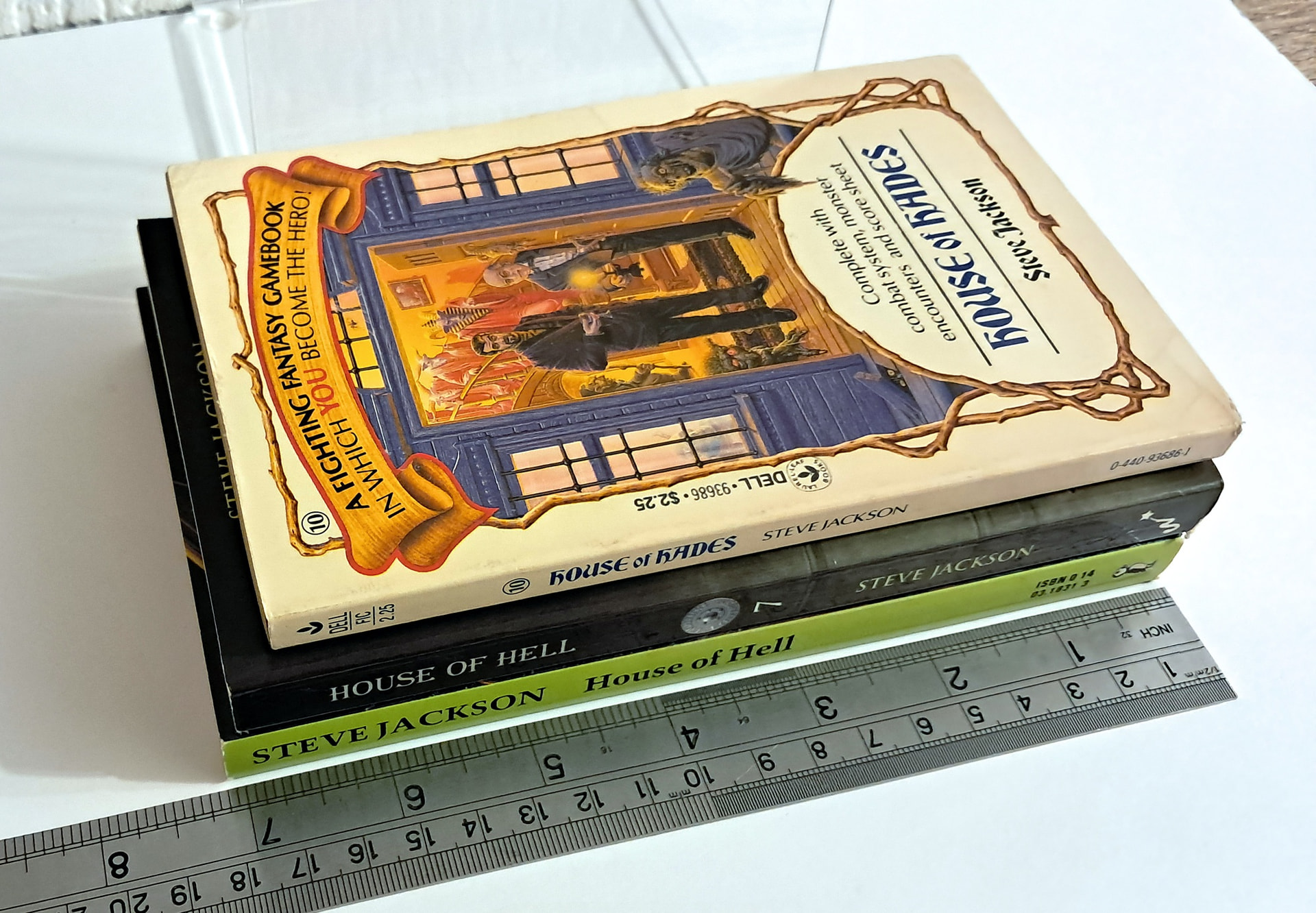
With the books I have been dealing with there are actually two different sizes that I’ve classed as UK A-format: the format that’s actually UK A-format, and a similar one which is actually slightly smaller, though only by a couple of millimetres. Both are slightly larger than what I think is the size that an American would call “mass-market paperback”.
In the photo below I’ve got, from bottom to top, UK A-format (Penguin/Puffin), the slightly shorter something-or-other format (Icon/Wizard Books), and the US paperback format that I think is “mass-market” (Dell / Laurel-Leaf).
I’ll also add that the similar-sized paperbacks made in other countries that I have are also a uniform size within themselves, but not the same size as any of the above - possibly excepting the French ones, which seem to be the same size (natural cutting variations aside) as the middle one.
I’ll also also add we’re missing “saddle stitched” (or stapled), and “perfect bound” as types of binding, if we’re enumerating the values of the types of property a book’s format might have.
All of the above books in the photo are perfect bound, I think; with glued-in pages.
This: La Ciudadela del Caos - books - ctlgs I noticed actually has stitched and glued signatures. The first time I’ve seen actual stitching on a small paperback (similar to the above books in size, but not the same ).
If we’re going to include comics with books we’ll need a load of size options… which we’d need separately anyway if we’re having comics separately, so there’s no escaping them.
I think it’s going to be challenging if we attempt to cater for every international variation of book publishing.
For instance Mass-Market Paperback and UK A-Format achieve the same ultimate goal: a more economical copy for high print-runs.
First impressions tend to be the most important (in this case you can judge a book by its cover)… The vast majority of the books I own are either Hardback or Paperback. Versions of the same book in these bindings come with different ISBN numbers, pricing etc. It should be as easy as possible to record that distinction.
When we get into Hardback books there are other distinctions that are interesting, like cloth-bound, leather/skin-bound. But at a certain point some information can just go in the notes.
I think a good start would be to introduce a new field for Cover type that has a small set of possible values, and to migrate matching values from the current Format field.
I agree that we should tend towards the simple with format, or we’ll end up even more confused than we are.
My primary request is that the description of the format accompanies the selection dropdown. This is the moment in the submission process that I’ll want to know what option is the right one, and if a description for “Mass-market Paperback” says it’s between this and this sort of height, and this and this sort of width, is on economical-quality paper, and includes US Mass-Market, UK A-format, and others that are equivalent with an established name, then I’d be happy, and not wracked with indecision about which one to go for!
As long as it’s clear why I pick, say ‘Mass-market Paperback’ over ‘Paperback’.
This is my goal - to be not confused!
Oh, and while I’ve remembered it, can we move the Format field to near the top of the edit form? I’m forever forgetting to put it in because it’s under the Credits.
I also think the names we choose should be logically presented, too. I don’t like that Mass-market Paperback is not sorted near Paperback. People, generally, will split their books into paperback and hardback, with a very few older and odd formats additional to that. Maybe we can whittle down the list of top-level formats to go along with Paperback and Hardback, and then either have sub-selections, or checkboxes, or both to catch distinct properties within.
What selection of values would you think might be good to place in this field?
I don’t really see the point in having ‘Hardback’ and ‘Board Book’ separate, or ‘Paperback’, ‘Soft cover’, and ‘Padded Baby Book’ separate - at top level - if we don’t also include all other variations there too. I wonder if it makes more sense to have nested options with multiple tag selections when it’s clearly possible to have several of them apply.
Hardback, Paperback, eBook, BARD Cartridge* at the top (maybe Magazine too for convenience), and specifics of binding types, internal paper types, usage types, sizes, and inclusion options/free-text, all as optional additional tags.
I can’t see how we can’t get away from allowing multiple format tags and still properly represent the range of books that there are.
* I don’t know if there are other books-on-non-printed-media that might be grouped with this.
What I’ve found so far for the european market at least, standard editions (so non collector items) are considered as miniature books up to 10 cm (3.94 inch).
I have no problem if we stick to the 3 inch rule but I see a risk of confusion with what is the next format larger than miniature (especially if international terms get translated). The next size/ format after miniature book would be pocket book, which I assume is smaller (or at least not larger) than what is shown in the picture by @xceque as the US (mass-market?) paperback, right?
Many countries in Europe use “pocket book” (in the respective national language) as the term for (mass market) paperback and different terms for trade paperback, like “Large Format” or “Soft Cover”. Here in Germany the actual word for trade paperbacks is the English “Paperback”.
Thanks for all of the feedback. I agree the formats field we inherited is a mess and should be simplified. I’d like to keep in mind how these fields will be used in the future. Is it just for display on the edition page, or for searching and filtering? We’ll eventually have improved browsing pages with filters on the side. Filtering by hardback/paperback would be useful to me some other the other options would be extreme, and may be better suited as tags or a free text description field, similar to how Discogs does it.
In terms of technical feasibility this is all possible.
Being able to filter by some format types would be useful - hardback, paperback, ebook, the Braille gizmo, magazine, mixed-formats (eg, with CD) and perhaps the more obviously-not-“paperback” types like pamphlet, broadside, etc, would be handy.
Some of the more esoteric ones like the specific size of paperback or hardback, or the usage/target-market (like baby book, board book) is less useful for filtering, but important for identification.
 ).
).